
Resolution Together and family mediation are both constructive, conversation-based ways of resolving matters arising from divorce and separation. At first glance, they can seem very similar, so it is no surprise that clients often ask us what the difference is. In this article, we explain how each option works, what they have in common and where they differ.
Family mediation
Family mediation involves you and your former spouse or partner having sessions with an independent third party, the mediator, to help you resolve financial and/or child-related matters ancillary to your divorce or separation. Commonly, couples have their own solicitors advising them in the background alongside the mediation process, and sometimes their solicitors can be in the mediation sessions themselves. Once an agreement is reached and recorded by the mediator, this is then drafted by the solicitors into an order to be submitted to the court for approval. Typically, family mediation requires around three to six sessions.
Resolution Together
Resolution Together (RT), often referred to as “one couple, one lawyer”, allows one solicitor to advise a divorcing or separating couple jointly, representing both parties. This can be in relation to financial matters and/or child-related matters. The solicitor will meet with the couple to advise on their legal options and review any proposals they may already have formulated. The solicitor can draft the order to be lodged with the court for approval. RT is only possible if there is no conflict of interest between the couple.

Family mediation vs Resolution Together: comparison table
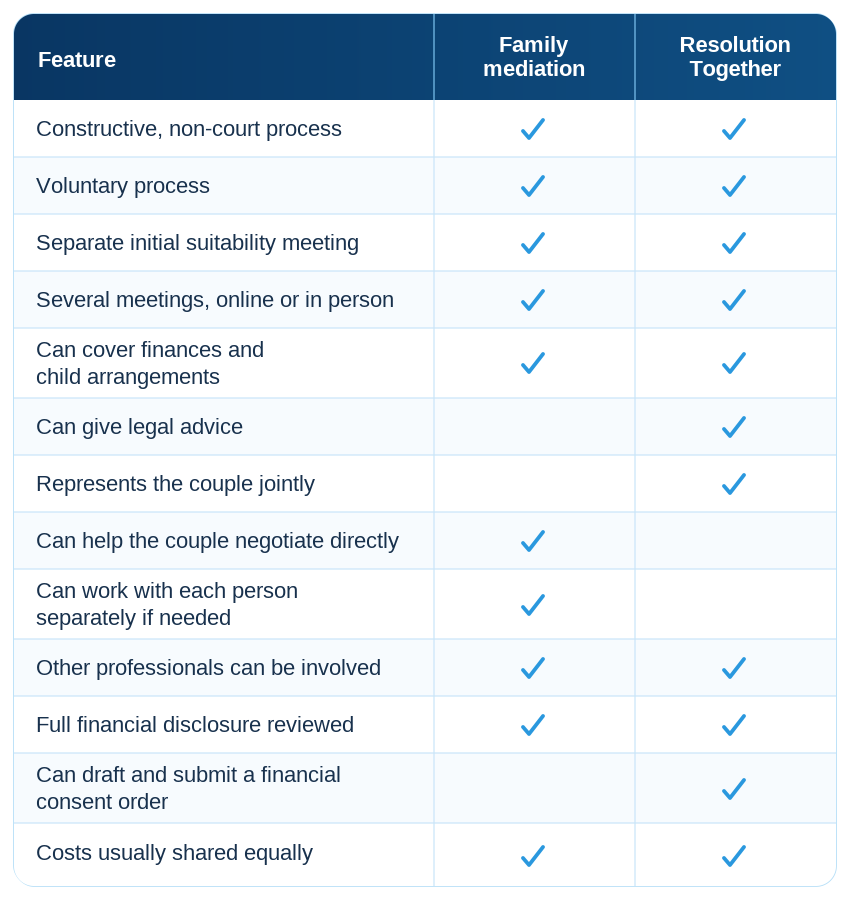
What features are the same or similar?
- They are both constructive ways of working to avoid going to court.
- They are both discursive and involve several meetings either in person or online.
- The mediator and RT solicitor will meet with each client separately before deciding whether mediation or RT is suitable.
- They can both be used to discuss financial matters and/or child-related matters.
- Both ways of working are holistic with other professionals such as a family and/or financial consultant being able to attend some or all the meetings too.
- They are both voluntary ways of working.
- Full financial disclosure is obtained and reviewed in both.
- The mediator or RT solicitor’s hourly rate is usually shared equally between the couple.
What are the differences between family mediation and Resolution Together?
- The mediator cannot advise the couple. The mediator can give legal information but not advice. The RT solicitor can give both legal information and advice.
- The mediator is neutral, meaning they do not represent either person, whereas under Resolution Together the solicitor represents the separating couple jointly, working in their shared interests towards a fair outcome.
- The RT solicitor can draft and submit any financial consent order to the court whereas the mediator does not usually draft the order and is not on the court record.
- The mediator can get into the negotiations with the couple and assist them to come to a resolution whereas the RT solicitor cannot do this as there would be a conflict of interest.
- The mediator can work with the couple in separate spaces, i.e. the partners can be in separate physical or virtual rooms if this is needed and appropriate. The RT solicitor would not usually do this as this would suggest there is a conflict which would bar the RT solicitor from working in the RT way.
When it comes to divorce and separation, finding the right approach can make all the difference. At Scott Bailey, we help our clients understand the options available to them so they can choose the route that best suits their circumstances. All four of our family law solicitors are Law Society accredited family mediators, with three also qualified as hybrid mediators, three trained in Resolution Together and three qualified as collaborative lawyers. This breadth of experience means we can offer a wide range of constructive, non-court-based options and help our clients identify the approach that is right for them.